
The Bolded Reading Method: A Comprehensive Guide to Visual Anchors and Cognitive Focus
Updated: Aug 1
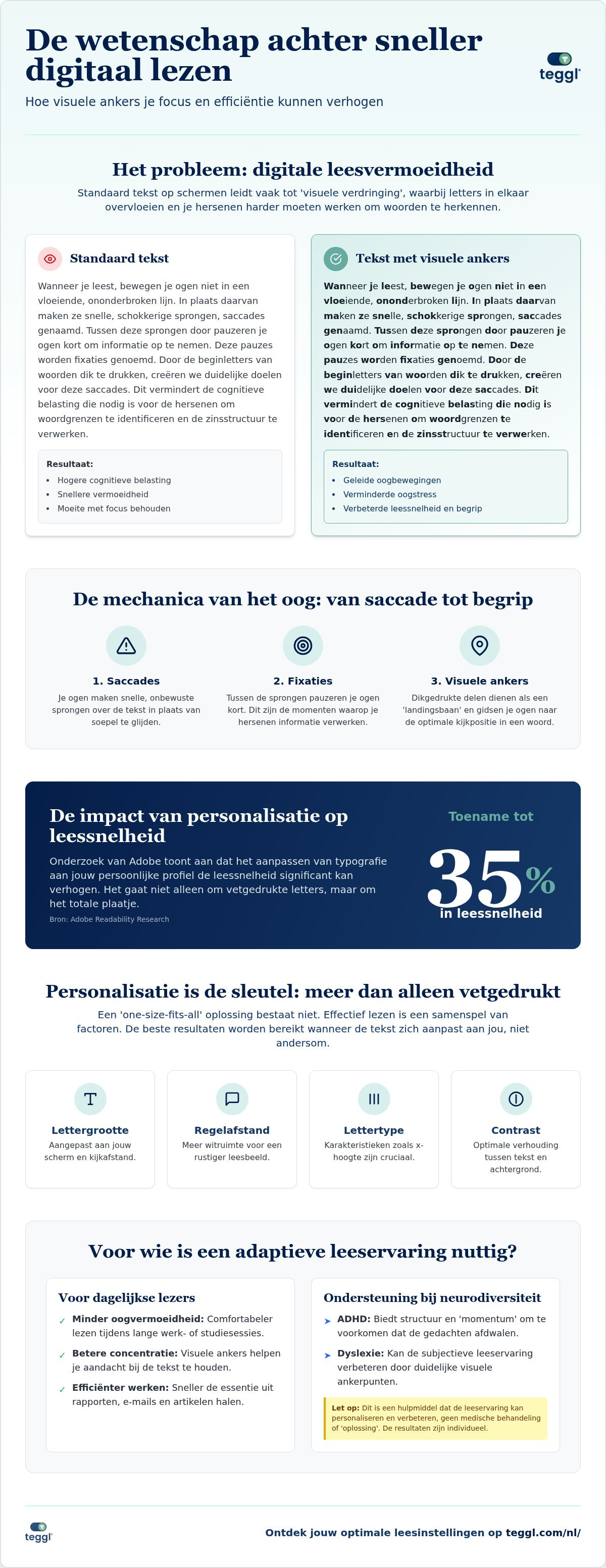
What if the secret to reading faster isn't about moving your eyes more quickly, but about giving them a better place to land? You've likely felt the frustration of losing your place halfway through a long article or battling the mental fog that comes with hours of screen time. It's a common struggle in our text-heavy world, and it often leads to a search for a more efficient tekst dikgedrukt lezen methode. By using bolded visual anchors to guide your gaze, you can stop fighting against standard web fonts and start working with your brain's natural processing power.
We understand that digital overload is real, but it doesn't have to be your default state. In this comprehensive guide, you'll discover the science behind bolded reading and why Adobe research suggests that personalized typography can increase reading speeds by up to 35%. We'll move from high-level cognitive theories to practical browser tools, giving you a clear path to higher comprehension and reduced eye strain. It's time to move past one-size-fits-all layouts and build a reading experience that truly fits your unique profile.
Table of Contents
Understanding the Bolded Reading Method: Mechanics and Visual Anchors
The bolded reading method is a typographic technique designed to streamline how our brains process digital information. Unlike traditional formatting, this approach uses artificial fixation points to guide the eye through a sentence. It transforms a block of text into a series of visual landmarks. This specific tekst dikgedrukt lezen methode doesn't just make words look different; it changes the mechanics of how you interact with them. It's a functional shift from passive reading to active, guided navigation.
When you read, your eyes don't move in a smooth, continuous line. Instead, they perform rapid, ballistic jumps called saccades. Between these jumps, your eyes briefly stop to take in information. These stops are known as fixations. By bolding the initial parts of words, we create clear targets for these saccades. This reduces the cognitive load required for the brain to identify word boundaries and process sentence structure. It's essential to distinguish this from traditional Emphasis in typography. While standard bolding is used to signal importance or emotion, functional bolding serves as a navigational tool for the visual system.
The Role of Fixation Points in Reading Speed
Our eyes have a narrow area of sharp focus called foveal vision. When you use a bolded reading mode, your foveal vision locks onto the high-contrast "onset" of a word. Meanwhile, your peripheral vision is already scouting for the next anchor. This coordination helps your eye land on the Optimal Viewing Position (OVP), which is the exact spot in a word that allows for the fastest recognition. By nudging the eye toward this point, the brain processes the word's meaning more efficiently, often leading to a smoother reading flow.
Visual Crowding: Why Standard Text Can Be Exhausting
Reading on high-density screens often leads to visual crowding. This phenomenon occurs when nearby letters interfere with your ability to recognize individual characters. It's a primary driver of digital eye strain and cognitive fatigue. Bolded anchors help "break up" the crowd by providing distinct markers that separate word units. Implementing a tekst dikgedrukt lezen methode through a browser extension can transform a cluttered page into a structured, readable environment, allowing you to maintain focus during deep work sessions without the usual mental drain.
The Science of Readability: Does Bolded Text Actually Work?
The effectiveness of a tekst dikgedrukt lezen methode is a subject of significant debate within the scientific community. Recent eye-tracking research from 2024 and 2025 shows that the human eye often continues to process entire words even when only the initial letters are bolded. These mixed results suggest that bolding isn't a universal "magic bullet" for speed. Instead, its value lies in how it functions as a visual anchor for specific cognitive profiles. When evidence is conflicting, we must look at the variables that drive individual success rather than searching for a one-size-fits-all solution.
Data from Adobe’s readability studies indicates that personalizing font settings can lead to a 35% increase in reading speed. This research highlights that "boldness" is just one component of a much larger equation involving x-height, character spacing, and contrast. These elements directly influence how fonts affect learning and memory recall. By treating text as a dynamic interface, we move away from static design and toward a more evidence-based approach to digital literacy.
Personalization vs. Universal Design
The search for a single "best" font is largely a myth because every visual system is unique. What works for one reader might cause visual crowding for another. This is why Teggl operates as an adaptive typography platform. It doesn't just apply a filter; it recalibrates the text based on your specific needs. To find the configuration that works for you, it's best to discover your optimal reading settings through a structured test rather than relying on generic presets.
Neurodiversity and Bolded Reading: ADHD and Dyslexia
For readers with ADHD, the tekst dikgedrukt lezen methode often provides the necessary "momentum" to prevent the mind from wandering during long passages. While we don't claim that this personalized reading technology cures dyslexia or ADHD, many users report a subjective improvement in focus and reduced mental fatigue. By emphasizing individual preference over universal standards, we create a more inclusive digital environment that supports diverse ways of processing information.
How to Implement Personalized Bolded Reading for Peak Performance
Transitioning from understanding the theory to mastering the tekst dikgedrukt lezen methode requires a structured approach. You can't just apply a static filter and expect immediate results; you need a system that adapts to your environment. Start by assessing your digital workspace. Factors like screen resolution and blue light levels significantly impact how your brain processes high-contrast anchors. Once your hardware is set, the next step is integrating a functional tool like the Teggl Browser Extension into your daily workflow.
This method is particularly effective for "Search-Reading," a technique used to scan academic papers or technical documentation for specific data. Instead of reading every word, you use the bolded anchors as a map to locate key concepts. A scientific analysis of bionic reading suggests that eye-tracking patterns change when visual cues are present, allowing for more purposeful movement across the page. This isn't about skipping content; it's about navigating it with intention.
Finding Your Optimal Reading Profile
Your first task is to take the Reading Profile Test. This isn't a one-and-done assessment. You'll test different "boldness ratios" to see which level of contrast triggers the highest comprehension for your unique visual system. Some readers thrive with heavy onsets, while others prefer a subtle nudge. For a deeper look at the tools available, check out our Bolded Reading Modus: The 2026 Buyer’s Guide to Personalised Reading Tools to see how different settings impact performance.
Beyond Bold: A Holistic Approach to Digital Reading
Typography is a multi-variable equation. Research from the School of Design at the University of Leeds highlights that line length, ideally around 70 characters, and inter-line spacing are just as vital as font weight. The Teggl Browser Extension combines these elements into a single adaptive experience. It doesn't just bold text; it recalibrates your entire screen based on your profile. This ensures that every article you read is optimized for your comfort, reducing the mental friction of the tekst dikgedrukt lezen methode and turning it into a seamless habit.
Master Your Digital Focus
The transition from standard web fonts to a personalized reading environment isn't just a trend; it's a necessary evolution in a text-heavy world. By understanding the mechanics of saccades and fixation points, you can move beyond the frustration of digital eye strain. The tekst dikgedrukt lezen methode provides the visual anchors your brain needs to navigate dense information with greater clarity and less fatigue. As research from Adobe suggests, when your typography matches your unique profile, performance follows naturally.
You don't have to settle for the default settings on your browser. Instead, take control of your cognitive load by aligning your digital environment with your visual system. This adaptive approach ensures that whether you're scanning technical documentation or deep-diving into a long-form article, your focus remains sharp. It's about building a sustainable reading habit that respects your physical well-being while pushing your productivity to new heights.
Ready to see the difference for yourself? Discover your optimal reading settings with the Teggl Reading Profile Test and start experiencing a more seamless way to process information today. You've got the tools to transform your digital world; it's time to use them.
Frequently Asked Questions
Is there a difference between Bionic Reading and the bolded reading method?
Bionic Reading is a specific proprietary implementation, while the bolded reading method refers to the broader typographic strategy of using visual anchors. The tekst dikgedrukt lezen methode focuses on creating artificial fixation points to guide your eyes through digital text. While the goals are similar, the implementation and level of personalization vary depending on the tool you choose to use.
Does the bolded reading method help with ADHD focus?
Many readers with ADHD report that bolded anchors provide the visual momentum needed to stay engaged with dense paragraphs. These anchors act as a roadmap, helping the brain maintain the thread of a sentence without getting distracted. It's not a medical cure, but it serves as a practical tool for managing cognitive fatigue during long deep work sessions.
Can I use bolded reading for printed books or just digital screens?
This method is primarily optimized for digital screens where visual crowding and screen glare are more prevalent. Digital tools allow for real-time adjustments to font weight and spacing that aren't possible with static print. While some specialized books use similar techniques, the flexibility of a browser extension makes digital reading the most effective environment for this method.
Will bolded reading improve my reading speed immediately?
Your results depend on your unique visual profile and how quickly your brain adapts to new typographic cues. Some users report an instant feeling of ease, while others see improvement after a few days of consistent use. Adobe research has shown that personalized fonts can increase reading speed by up to 35%, which highlights why individual settings are more important than the method alone.
Is the bolded reading method scientifically proven?
Scientific evidence in this field is currently mixed, as different studies show conflicting results regarding universal speed increases. However, research into personalized readability emphasizes that there's no single solution for everyone. The success of the tekst dikgedrukt lezen methode often comes down to how well the settings are tailored to your specific cognitive and visual requirements.
How do I turn on bolded reading in my browser?
You can activate this feature by installing the Teggl Browser Extension. Once it's installed, the first step is to complete the Reading Profile Test to identify your optimal settings. This ensures your Bolded Reading Mode is perfectly calibrated to your eyes, providing a seamless and efficient experience across every website you visit.
Comments