
The Best Online Article Reading Boosters of 2026: A Scientific Comparison
Did you know that the "perfect font" doesn't actually exist, but the right personalized settings can boost your reading speed by up to 35%? Most of us are familiar with that mid-afternoon wall where words start to blur and you find yourself re-reading the same paragraph three times. It's exhausting to battle digital eye strain and cognitive overload just to stay informed during a busy workday. You've likely felt the frustration of skipping lines or losing focus after only twenty minutes of screen time. It's a common struggle in our text-heavy world, but it isn't a personal failing.
You don't have to settle for a static, one-size-fits-all experience. We'll show you how a high-quality online article reading booster can transform dense digital text into a seamless flow of information that matches your unique cognitive profile. This scientific comparison explores the top tools of 2026. We examine peer-reviewed research on x-height, spacing, and bolding to help you achieve better retention with significantly less mental fatigue.
Table of Contents
The Science of Visual Crowding: Why You Need an Online Reading Booster
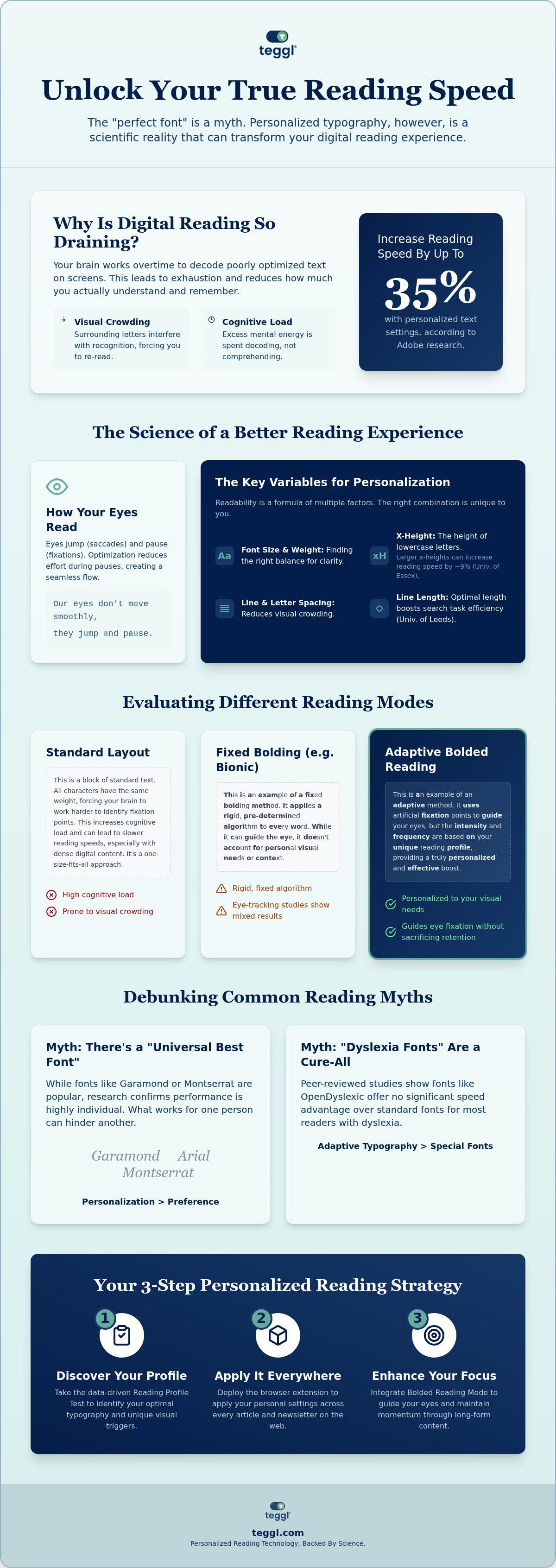
Digital screens present a unique challenge known as visual crowding. This phenomenon occurs when surrounding characters interfere with your ability to recognize individual letters, forcing your brain to work harder just to see the words. This exhaustion stems from Cognitive Load Theory. When you spend excessive mental energy decoding text, you have less capacity left for actual comprehension. Using an effective online article reading booster helps mitigate this by optimizing your visual environment. Research from Adobe demonstrates that personalization is the key to overcoming these barriers, showing that users can achieve a 35% increase in reading speed when text is tailored to their specific needs.
To understand why these boosters work, we must look at The Science of Eye Movement in Reading. Our eyes don't move smoothly across a page; they jump in saccades and pause in fixations. Personalized readability minimizes the effort required during these pauses, turning digital consumption from a chore into a seamless flow. This shift marks the next frontier in digital productivity, moving beyond static layouts toward an adaptive experience.
Typography and the Brain: Research from Leeds and Essex
University of Leeds findings indicate that specific line lengths and generous spacing significantly boost efficiency during search reading tasks. Meanwhile, data from the University of Essex suggests that larger x-heights, specifically around 5.0 mm, can improve reading age and speed by approximately 9%. It's vital to distinguish between legibility, the simple recognition of letters, and readability, the ease of processing entire sentences. An online article reading booster focuses on the latter, ensuring your brain spends less time on mechanics and more on meaning. By adjusting these variables, you create a frictionless experience that supports your cognitive health throughout the workday.
Evaluating Reading Boosters: Bolded Reading vs. Bionic Reading vs. Standard Layouts
Traditional reading boosters usually focus on phonics or drills designed for early learners. Modern optimization tools, however, act as sophisticated UI/UX extensions that transform the digital interface for professional readers. The bolded reading modus is a prime example of this evolution. It uses artificial fixation points to guide your eyes through text, significantly reducing the cognitive load spent on navigating dense blocks of information. While some proprietary methods like Bionic Reading have shown mixed results in recent eye-tracking studies, the true value lies in personalization rather than a fixed algorithm.
It's time to retire the myth of a "universal best font." While some claim Montserrat or Garamond are objectively superior, scientific research confirms that what works for one person might actually hinder another. When you evaluate reading comprehension tools, prioritize those that offer personalization based on scientific integrity. A high-quality online article reading booster understands that performance is a variable. It adapts to your specific needs rather than forcing you into a static, rigid layout.
The Reality of Dyslexia-Specific Fonts
Peer-reviewed studies on specialized fonts like Dyslexie and OpenDyslexic reveal a surprising truth. These designs offer no statistically significant speed advantage over standard options like Arial or Times New Roman. Most readers actually report a preference for standard fonts when they can control spacing, contrast, and weight. Adaptive typography proves far more effective than any single "special" font because it addresses individual visual triggers. It's about finding what fits you. You can take a Reading Profile Test to discover which combinations provide the most clarity for your workday.
How to Build a Personalized Reading Strategy with Teggl
Transforming your digital experience starts with moving from static text to an adaptive environment. Don't guess what works; use a data-driven approach to find your peak performance settings. First, take the Reading Profile Test to identify your unique visual triggers and optimal font weight. Once you've discovered your profile, deploy the browser extension to apply these settings across every article and newsletter you encounter. This creates a consistent, high-performance online article reading booster that follows you across the web.
To maintain momentum during long-form technical content, integrate Bolded Reading Mode. This feature uses artificial fixation points to guide your eyes, preventing the mental wandering that often occurs with dense text. Finally, audit your digital environment by adjusting your layout for maximum comfort. Aim for a line length of approximately 70 characters and interlinear spacing of 14pt. These specific adjustments reduce the physical effort of tracking, letting you focus entirely on the meaning behind the words rather than the mechanics of the screen.
Maximizing Productivity While Reducing Digital Fatigue
It's possible to reduce online reading distractions by combining a digital online article reading booster with dedicated focus modes. In high-stress professional environments or for those navigating ADHD, Bolded Reading acts as a powerful focus anchor. It keeps your eyes locked on the current line, preventing the cognitive drift that leads to frustrating re-reading cycles. By prioritizing visual ergonomics, you'll avoid the common 3 PM slump caused by screen exhaustion. You aren't just reading faster; you're protecting your mental energy for the tasks that matter most. This proactive strategy ensures you remain sharp and focused until the end of your workday.
Take Control of Your Cognitive Performance
Digital overload doesn't have to be your default state. By understanding the science of visual crowding and implementing an online article reading booster, you can transform how you process information. Research from institutions like Adobe, Leeds, and Essex highlights that the key to efficiency isn't a single perfect font; it's a layout tailored to your unique visual profile. You've learned how personalized typography reduces cognitive load and prevents the mid-afternoon slump. Now, it's time to move from theory to peak performance. Evidence-based optimization is finally within reach, allowing you to read faster while maintaining deep comprehension.
Don't let dense text drain your mental energy. Take the Teggl Reading Profile Test and boost your speed today. It's a simple step toward a more focused, frictionless workday. You deserve a reading experience that works with your brain, not against it.
Frequently Asked Questions
Do online reading boosters really improve comprehension?
An effective online article reading booster improves comprehension by reducing the mental energy spent on decoding characters. When visual crowding is minimized through optimal spacing and font weight, your brain can dedicate more resources to processing the narrative. Research suggests that while speed increases, comprehension levels remain stable or even improve when specific variables like x-height are optimized for the reader's unique needs.
What is the best font for reading long articles online?
Scientific evidence confirms that no single font is universally superior for every reader. While some studies highlight specific typefaces as effective for certain groups, individual performance varies significantly. It's most effective to use personalized technology to identify which font weight and style align with your unique visual profile rather than relying on a static, one-size-fits-all solution for your digital reading.
Is Teggl's Bolded Reading better than Bionic Reading?
Teggl's Bolded Reading Mode differs from Bionic Reading by prioritizing user-controlled personalization over a fixed algorithm. While Bionic Reading applies a standard bolding pattern, Teggl utilizes a Reading Profile Test to determine the exact intensity that works for you. This adaptive approach is designed to align with your specific cognitive needs rather than applying a generic layout change that may not yield objective improvements.
Can a reading booster help with ADHD or dyslexia symptoms?
While an online article reading booster isn't a cure for ADHD or dyslexia, it serves as a powerful accessibility tool. These technologies help manage symptoms like line-skipping and loss of focus by providing clear visual anchors. By adjusting variables such as interlinear space and font weight, readers often experience reduced mental fatigue and a more stable focus during long periods of digital consumption.
Comments