
Teggl Review 2026: The Science of Adaptive Typography and Bolded Reading
Did you know that switching to a font optimized for your unique vision can increase your reading speed by up to 35%? Most of us spend our days staring at dense digital reports, battling visual crowding and mental exhaustion. You've likely felt that familiar strain where standard web fonts seem to blur together, making it nearly impossible to maintain focus. This Teggl review explores how moving beyond static typography can transform your cognitive performance and physical well-being.
You'll learn how to use evidence-based personalization to process information faster while significantly reducing digital eye strain. We'll break down the science behind the Reading Profile Test, the mechanics of Bolded Reading mode, and how to build a digital environment that fits your specific cognitive profile. It's time to stop fighting against your screen and start using technology that adapts to you.
Table of Contents
Decoding the Teggl Review: Beyond the 'Teagl' and 'Toggl' Confusion
Searching for a Teggl review often leads readers down a rabbit hole of misspellings like "Teagl" or unrelated software like Toggl. While Toggl tracks your minutes, Teggl optimizes your information processing. It isn't just a static font; it's a personalized reading technology designed for a 2026 digital landscape where standard web defaults often cause significant cognitive burnout. We've moved past the era where one-size-fits-all layouts are acceptable. For neurodivergent readers, these adaptive tools provide essential sensory comfort and focus support. Understand that Teggl offers a way to manage focus without claiming to cure conditions like ADHD or dyslexia.
High-quality digital environments often look to Wikipedia's Readability Guidelines for baseline accessibility. However, Teggl takes this further by allowing the user to control the environment directly. This shift from passive consumption to active environmental control is the foundation of modern digital wellness.
The Myth of the Universal Best Font
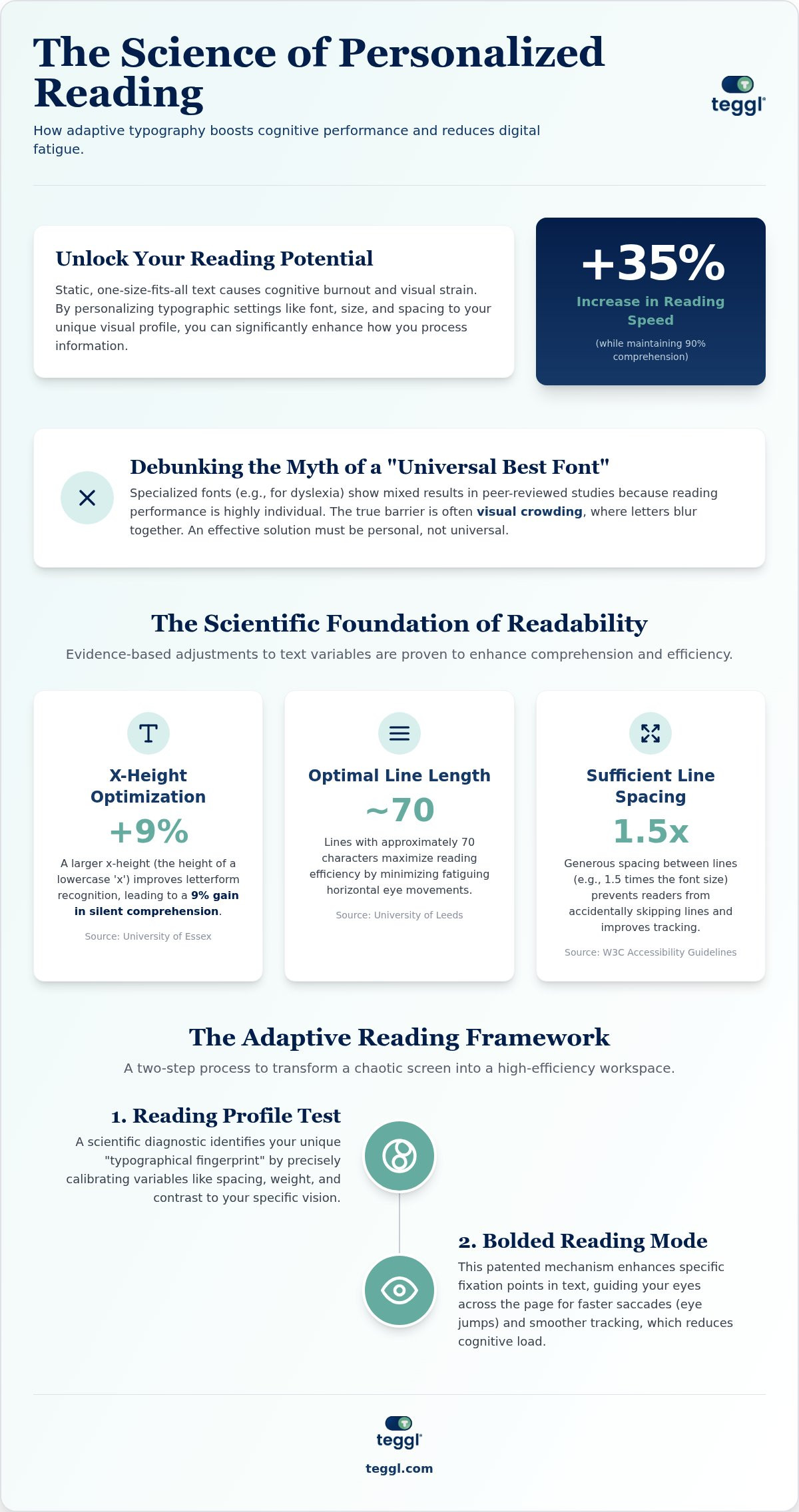
Many people assume specialized fonts like Dyslexie or OpenDyslexic are the ultimate solution for readability. In reality, peer-reviewed research shows mixed results regarding their effectiveness. This happens because reading performance is highly individual. A font that helps one person might actually slow another down. The core struggle is often visual crowding, where characters seem to blur or overlap during long-form reading. Static typefaces simply cannot account for these personal differences. By moving toward a personalized bolded reading modus, you can implement variable text optimization. This approach ensures your Teggl review experience is based on your unique visual fingerprint, providing the clarity you need to process dense reports without the typical exhaustion.
The Scientific Foundation of Personalized Readability and Adaptive Typography
Reading performance isn't a fixed trait; it's a variable that responds to environmental tuning. During an eight hour screen day, character width and weight play a critical role in mitigating visual stress. Adobe research shows that personally optimal fonts can increase reading speed by 35% while maintaining a 90% comprehension rate. This Teggl review confirms that these gains aren't accidental. They're the result of reducing the cognitive load required to distinguish between similar letterforms. When your screen adapts to your vision, your brain spends less energy on decoding and more on synthesis.
University of Essex data highlights that even minor adjustments to x-height can lead to significant breakthroughs in silent comprehension. In high pressure academic tasks, Leeds University studies found that specific layout principles achieved statistical significance (p < 0.01) for efficiency. While Verdana often outperforms Sassoon Primary in digital contexts, the "best" setting is always individual. You can learn how to reduce online reading distractions by applying these structural principles. If you're curious about your own metrics, you can test your reading speed to see these variables in action.
Section Summary:
Personalized typography reduces visual stress and boosts speed by up to 35%.
Scientific data from Essex and Leeds proves that x-height and line length are primary drivers of comprehension.
This Teggl review emphasizes that adaptive tools are essential for maintaining focus during long form digital consumption.
The Teggl Framework: Implementing Adaptive Reading in Your Browser
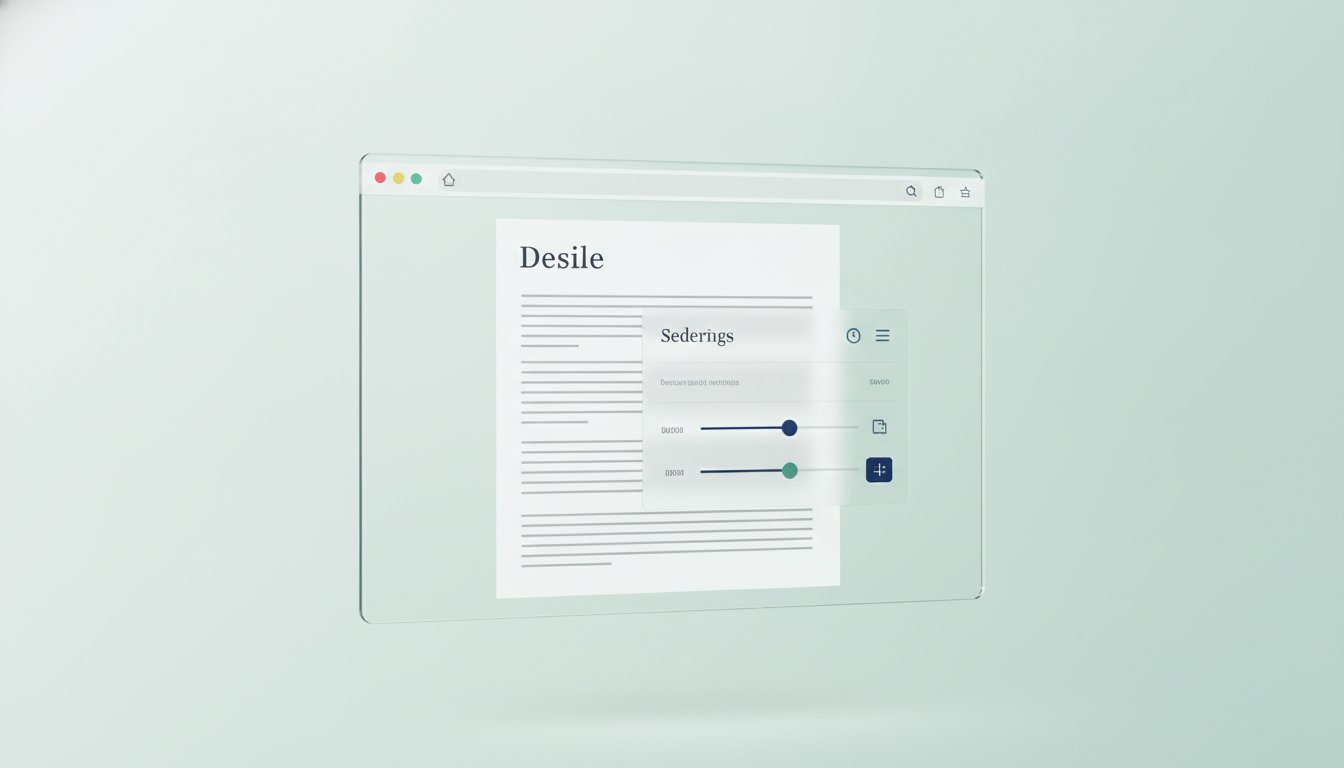
The Teggl Framework begins with the Reading Profile Test, a scientific diagnostic that identifies your unique typographical fingerprint. This isn't a one-size-fits-all solution; it's a precise calibration of spacing, weight, and contrast tailored to your vision. Once your profile is set, the Bolded Reading mode enhances specific fixation points to guide your eyes across the page. This mechanism facilitates faster saccades and smoother tracking, which significantly reduces the cognitive load required to process complex text. Any comprehensive Teggl review must highlight how this system transforms a chaotic screen into a structured, high-efficiency workspace. It's a sophisticated evidence-based innovation designed to help professionals master the information density of 2026 without sacrificing mental clarity.
Optimizing Your Personalized Reading Environment
Implementing these tools into your daily workflow is a simple, three-step process. First, complete the Reading Profile Test to establish your baseline settings. Second, activate the extension and let it sync with your profile. Finally, modulate the Bolded Reading intensity based on your current cognitive state. For rapid skimming of emails, a higher bolding intensity creates clearer visual anchors for quick navigation. For deep analysis of dense reports, a lower setting provides subtle support that effectively mitigates visual crowding and prevents accidental line-skipping. This actionable strategy allows you to maintain peak focus during grueling deep-work sessions. By adjusting your digital environment to fit your specific needs, you eliminate the friction that typically leads to mental exhaustion.
Take Control of Your Digital Performance
Reading in 2026 doesn't have to be a source of mental exhaustion. This Teggl review has explored how moving beyond standard web defaults can unlock significant productivity gains. By applying Adobe's research on personalized readability and the University of Essex's data on font performance, you can transform your screen into a high-performance environment. You've seen how Leeds University layout standards help reduce visual crowding and line-skipping, making deep work more sustainable. It's time to stop settling for a one-size-fits-all experience and embrace a platform that adapts to your unique cognitive profile.
Discover your optimal reading settings with the Teggl Reading Profile Test and start processing information with greater clarity today. You have the power to optimize your visual environment; let technology work for you.
Frequently Asked Questions
Can a personalized font really improve my reading speed by 35%?
Yes, Adobe research indicates that personalizing font choice can increase reading speed by up to 35% while maintaining 90% comprehension. This occurs because visual processing is highly individual. What works for one person might cause visual crowding for another. This Teggl review notes that the extension applies these findings by letting you test and select the specific typography that matches your visual profile.
Does OpenDyslexic or Dyslexie font actually help with reading accuracy?
Research on specialized fonts like OpenDyslexic or Dyslexie shows mixed results in peer-reviewed studies. While some users report a subjective improvement in clarity, others find no significant change in reading speed or accuracy. Performance depends on individual variables like character spacing and x-height rather than a specific font design. Teggl focuses on these adaptive variables rather than a single static typeface.
What is the most legible font size for digital reading according to research?
There is no single most legible font size because screen quality and viewing distance vary. However, University of Essex research highlights that a larger x-height, often found in sizes around 14pt or larger, can improve comprehension by 9%. Most experts recommend starting with at least 16px for body text and adjusting based on your specific monitor resolution and personal comfort levels.
How does the Teggl Reading Profile Test determine my optimal settings?
The Reading Profile Test is a scientific diagnostic that measures your reading speed and comprehension across different typographical settings. It evaluates how you react to changes in font weight, character spacing, and line height. By analyzing these performance metrics, the test identifies your unique typographical fingerprint. It then configures the browser extension to match the environment where you process information most efficiently.
Will Teggl help with ADHD-related reading distractions?
Teggl provides tools that support focus and reduce visual noise, which can be helpful for readers with ADHD. The Bolded Reading mode creates clear visual anchors that guide the eyes through dense text. While it doesn't cure ADHD, it minimizes the visual crowding and clutter that often lead to distractions. This creates a more soothing and organized reading environment for better concentration during deep work.
How does Teggl's Bolded Reading mode differ from standard bolding techniques?
Yes, Teggl's Bolded Reading mode is a more sophisticated and personalized implementation of the principle of visual guidance through bolding. While many existing bolding methods use a fixed bolding pattern, Teggl allows you to adjust the bolding intensity based on your Reading Profile Test results. This Teggl review confirms that the extension adapts fixation points to your specific cognitive needs, ensuring smoother tracking and faster information processing.
Comments